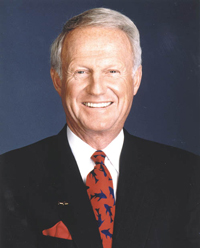
Harvey Mackay

Type: Text Feature
Categories: Business & Finance.

Get This Feature

Harvey Mackay offers inspirational career advice in his weekly syndicated column. Founder, chairman of the board and chief executive officer of Mackay Envelope Corporation, Mackey is an internationally sought after public speaker who was named one of the top five speakers in the world by Toastmasters International.

Harvey-mackay

View more samples

Harvey Mackay

Mackay_harvey

Harvey Mackay is the founder, chairman of the board and chief executive officer of Mackay Envelope Corporation. He is an internationally sought after public speaker who was named one of the top five speakers in the world by Toastmasters International.

Mackay's fourth book of business advice, Dig Your Well Before You're Thirsty: The Only Networking Book You'll Ever Need (Currency/Doubleday) made The New York Times best seller list 12 days after its release. His Swim With the Sharks Without Being Eaten Alive was a New York Times No. 1 best seller for 54 weeks and was named the No. 1 business book in America in 1988. Mackay also wrote the best sellers Beware the Naked Man Who Offers You His Shirt and Sharkproof. His books have sold more than 7 million copies worldwide.

An active civic leader, Mackay led the $6 million ticket buyout to keep the Minnesota Twins in Minnesota, was a catalyst for getting the Metrodome stadium built and was instrumental in bringing the Super Bowl to Minneapolis in 1992. He is a graduate of the University of Minnesota and the Stanford University Business School Advanced Management Program. Mackay's business insights have been featured in The Harvard Business Review, Inc., Reader's Digest and many other publications. Mackay is a member of numerous boards of directors including Robert Redford's Sundance Institute.

Mackay and his wife have three children, five grandchildren, and reside near Minneapolis.

Meet the Cast of Harvey Mackay

  • EVERYONE IS A SALESPERSON

    Everyone is a salesperson, all of your life. Whether you are a mechanic, a teacher or a manager, you are selling ideas. You are negotiating. You are communicating, persuading, influencing.

    If you don't believe you are a salesperson, I encourage you to rethink your position because the probability that you will become successful is significantly diminished.

    This is the lesson I would give to people who might tell me that my most recent book is not for them. "The Mackay MBA of Selling in the Real World" is for everyone, especially now.

    The hardcover edition was published in November 2011. The paperback version was just released and contains 10 new chapters and nine new "quickies," including sections on such important topics as relationships/networking and time management. I'd like to share a preview of the new material.

    Networks are the foundation of business. Robert Kiyosaki, author of "Rich Dad, Poor Dad," hit the nail on the head when he wrote: "The richest people in the world look for and build networks. Everyone else looks for work."

    Ace networkers learn to master the navigation and the niceties that earn them acceptance, respect and authority. Here are three road-tested tips:

    1. Create timelines for your networking goals. Be patient. Understand that it may take one or two years to position yourself in a network. Always plan the supporting network routes to business objectives far ahead. Totally determined to sell a major prospect and ready to make a proposal in 18 months? Is the buyer an opera buff or dedicated to funding a dialysis center? Are you building a network path to mesh with those passions?

    2. Don't stall answers. When you acquire a serious network presence, you'll be asked for favors in no time. Don't be slow to answer calls, even if you can't promise your contact much help. Networks telegraph who the fast responders are and who the slowpokes are. The biggest mistake you can make is not to answer a viable network member who is reaching out to you. That remains true even if it's just to tell the person "no" in a clear and polite way.

    3. Act confidently and take meaningful risks. In networking, as in anything else, the wise person isn't the one who makes the fewest mistakes. It's the one who learns the most from them.

    Discussing time management, my favorite lesson comes from the late Peter Drucker, who said, "Until we can manage time, we can manage nothing else."

    We all start out in life with one thing in common: the same number of minutes and hours in each day. So why do some people accomplish so much, and others very little? Because so few of us have learned to beat the clock.

    For a salesperson, time isn't next to money in the asset column. It IS money. Perhaps the most important lesson I ever learned is that not everyone's clock ticks to the same drumbeat. I poked around and learned that 9-to-5 didn't have to be 9-to-5. It didn't matter how my clock ticked. What mattered was how my prospects' clocks ticked.

    Some buyers came in at 6 a.m. Some worked until 7 p.m. Some worked Saturday mornings. That boiled down to an edge, if I chose to use it -- for three hours every morning, two hours every afternoon and four hours on Saturday. This was invaluable competition-free time. Naturally, these time slots turned out to be my most productive opportunities.

    So I changed the playing-field clock. Then I changed my contact tactics. Cold calls were out. I always called ahead to make sure the buyer was in. I made creative appointments and asked for only 300 seconds of the buyer's time. Sounds basic, but the message said my product was special. It was as special as the working hours of my customers.

    Not only did these details help me manage my own schedule more efficiently; they helped guarantee that I was up to bat when the prospects were greatest for a maximum payoff.

    Along with these two subjects, I've added chapters on topics including how to be prepared should you ever lose your job, executive intelligence and the importance of volunteering.

    Will any of these ideas require major changes? Probably not, but I hope they help you see the importance of selling skills for success in any field.

    Mackay's Moral: You've heard me say it many times: "Little things mean a lot -- not true. Little things mean everything."


    (Harvey Mackay is the author of the New York Times best-seller "Swim With the Sharks Without Being Eaten Alive." He can be reached through his website, www.harveymackay.com, by emailing harvey@mackay.com or by writing him at MackayMitchell Envelope Co., 2100 Elm St. SE, Minneapolis, MN 55414.)

    COPYRIGHT 2013 HARVEY MACKAY

    published Monday, May 06, 2013

Contact our sales team: